Canadian Army
Never Cry WolfThe Canadian Army appears in the account of the 1946 Churchill wolf panic as both a force mobilized against a supposed danger and a camp transformed by fear. A soldier’s report prompted an armed search across the surrounding country, but the hunt produced casualties among people and dogs, a false sighting, and finally a single sick wolf. The episode shows how quickly alarm could turn an uncertain encounter into a widely repeated story of invasion.
The reported threat and military response
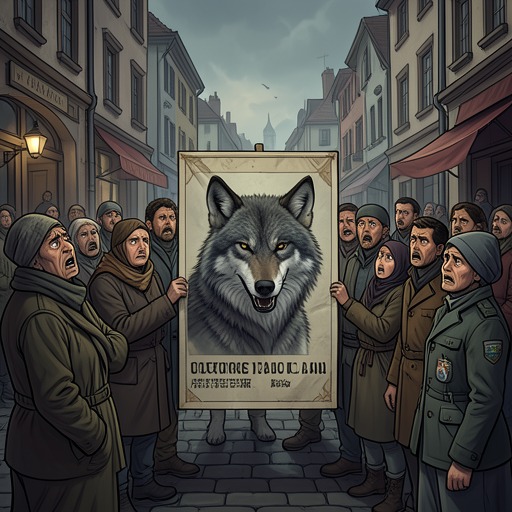
The panic began when a Canadian Army corporal returning to barracks after visiting the Churchill beer hall encountered a wolf. In his account, it had leaped at him with murderous intent; he said he escaped by running a mile to the guardhouse. He could show no physical evidence of the encounter, but his warning set off a near-hysterical response in the camp.
American and Canadian contingents were mobilized. Armed squads went out with rifles, carbines, and spotlights to search the surrounding country. The reported danger quickly expanded in scale: what began with one encounter became, in the searchers’ expectation, several packs of starving wolves. The account presents the mobilization as an institutional response driven by the corporal’s report and the fear it generated, rather than by verified evidence of a large wolf presence.
Costs and mistaken sightings
The armed search itself brought casualties. Eleven Husky dogs, an American private first class, and a Chippewayan person returning home late became casualties of the vigilantes, not of a wolf. For two days, women and children stayed indoors. Foot soldiers nearly disappeared from the camp, while men sent to distant buildings travelled by jeep and well armed, or did not go at all. The alarm thus altered daily life well beyond the search parties.
On the second day, a light Army aircraft joined the hunt and its crew glimpsed what seemed to be a wolf. A detachment of the Royal Canadian Mounted Police went out to deal with it; the animal proved to be a cocker spaniel belonging to the Hudson’s Bay Company manager. The sighting, initially consistent with the camp’s expectations, instead supplied a concrete measure of how easily the search could mistake an ordinary dog for the feared animal.
The actual wolf and the end of the panic
The panic eased on the third day. Late that afternoon, an Army truck returning from the airport came upon a bundle of fur on the road. Its driver braked but could not stop in time. The animal was a wolf, so sick that it could no longer move; the truck killed it. The account identifies this lone, incapacitated animal—not attacking packs—as the only wolf encountered in the episode’s closing events.
Memory and significance
The aftermath outlasted the search. Residents of Churchill and soldiers elsewhere continued to recount an invasion by wolves, adding stories of personal encounters, attacks on families, torn dog teams, and a community under siege. In the book’s telling, those later accounts enlarged the original report and the brief panic into a durable legend. The Canadian Army’s mobilization is central to that contrast: its scale reflected the perceived danger, while the search’s mistaken sighting and the final discovery of one gravely ill wolf revealed how little the available evidence supported the image of a mass attack.